North Carolina volleyball is best understood as a hybrid scene: part high school pipeline, part college volleyball state, part fast-growing club market, and part outdoor volleyball destination along the coast. It does not have the single-sport identity of a traditional volleyball powerhouse like Nebraska, Texas, California, or Hawaii, but it has one of the more interesting volleyball ecosystems in the Southeast because the sport is spread across several different layers. The Triangle gives the state a major college presence. Charlotte adds population density, club growth, and recruiting volume. The Triad has school-based competition and regional club activity. The mountains and coast give North Carolina a recreational volleyball texture that makes the sport feel broader than just the fall indoor season.
At the top, North Carolina has credible NCAA volleyball visibility through ACC programs such as North Carolina, NC State, Duke, and Wake Forest, with the broader college scene extending into programs such as Appalachian State and other in-state universities. The University of North Carolina, NC State, Duke, and Appalachian State all maintain active women’s volleyball programs, giving the state a wide range of college volleyball settings from Chapel Hill and Raleigh to Durham and Boone.
That college presence matters because North Carolina’s volleyball identity is not built around one isolated program. It is built around density. A player growing up in the state can see ACC volleyball, mid-major volleyball, high school championships, junior club tournaments, college camps, and regional recruiting activity without leaving the state. That makes North Carolina a serious volleyball market even if it is still chasing the national reputation of the country’s most established volleyball states.
The Triangle Gives North Carolina Its Volleyball Center of Gravity
The Triangle is the most important volleyball region in North Carolina because it combines college athletics, population growth, strong schools, and club access. Chapel Hill, Raleigh, Durham, and the surrounding suburbs create the kind of year-round volleyball environment that helps a state move from casual participation to a true development pipeline. Players in this part of the state are close to ACC gyms, competitive high school programs, private training, and junior clubs that feed the regional tournament circuit.
UNC brings the historical brand name. NC State gives Raleigh a major public-university volleyball presence. Duke adds a private-school ACC program with its own recruiting reach and academic-athletic profile. Wake Forest, while located in Winston-Salem rather than the Triangle, adds another ACC point in the state’s broader volleyball map. The ACC’s current volleyball structure also keeps North Carolina programs connected to a league with national-level programs and a demanding conference schedule. In 2025, North Carolina finished 14–6 in ACC play and 22–9 overall, a useful example of how the state’s top college volleyball presence can operate at a strong conference level.
The result is a volleyball culture where the college game is visible but not isolated. A high school outside hitter in Cary, a libero in Apex, a setter in Chapel Hill, or a middle blocker in Raleigh can grow up seeing what higher-level volleyball looks like at close range. That matters in a sport where the jump from school competition to serious club volleyball to college recruiting depends heavily on exposure, repetition, and coaching.
North Carolina volleyball also benefits from the state’s broader athletic culture. Basketball and football still dominate the public imagination, but volleyball has found room to grow because the state already values school sports, college rivalries, and regional competition. Volleyball fits naturally into that environment. It has the gym atmosphere, the school identity, the rivalry structure, and the tournament rhythm that North Carolina sports fans already understand.
High School Volleyball and the Shape of the Pipeline
North Carolina’s high school volleyball scene is one of the sport’s most important foundations in the state. The NCHSAA organizes girls volleyball with a fall calendar that includes first practices in late July, first contests in August, playoff bracketing in October, and postseason competition moving through the fall. That structure gives volleyball a defined place in the school sports year, especially in suburban and smaller-city communities where high school athletics remain a major part of local identity.
The state’s high school volleyball map is broad rather than concentrated in one city. The Charlotte area produces depth because of population size and private-school competition. The Triangle benefits from strong public schools, club access, and college proximity. The Triad has a mix of established school programs and regional rivalries. Smaller towns often build volleyball identity around multi-sport athletes who compete in school gyms before moving into club or college opportunities.
This is where North Carolina’s volleyball development becomes more layered. The best athletes are not always volleyball-only players early in their careers. Some come from basketball, softball, track, or soccer backgrounds and bring jumping ability, lateral movement, arm speed, or competitive instincts into the gym. Over time, the stronger players separate through serve receive, court vision, blocking discipline, setter-hitter tempo, and defensive consistency. The state’s best programs are not just producing tall hitters; they are producing players who understand rotations, transition offense, ball control, and the pressure of postseason volleyball.
The growth of junior clubs has changed the expectations around the sport. A player who wants to reach a college roster now usually needs more than a good high school season. Club volleyball supplies the volume: more touches, more specialized coaching, more tournament matches, and more exposure to recruiters. In North Carolina, that means the serious player pathway often runs through both school and club, with each side serving a different role. School volleyball provides identity, leadership, and local rivalry. Club volleyball provides refinement, travel competition, and recruiting visibility.
Indoor Volleyball Defines the Competitive Core
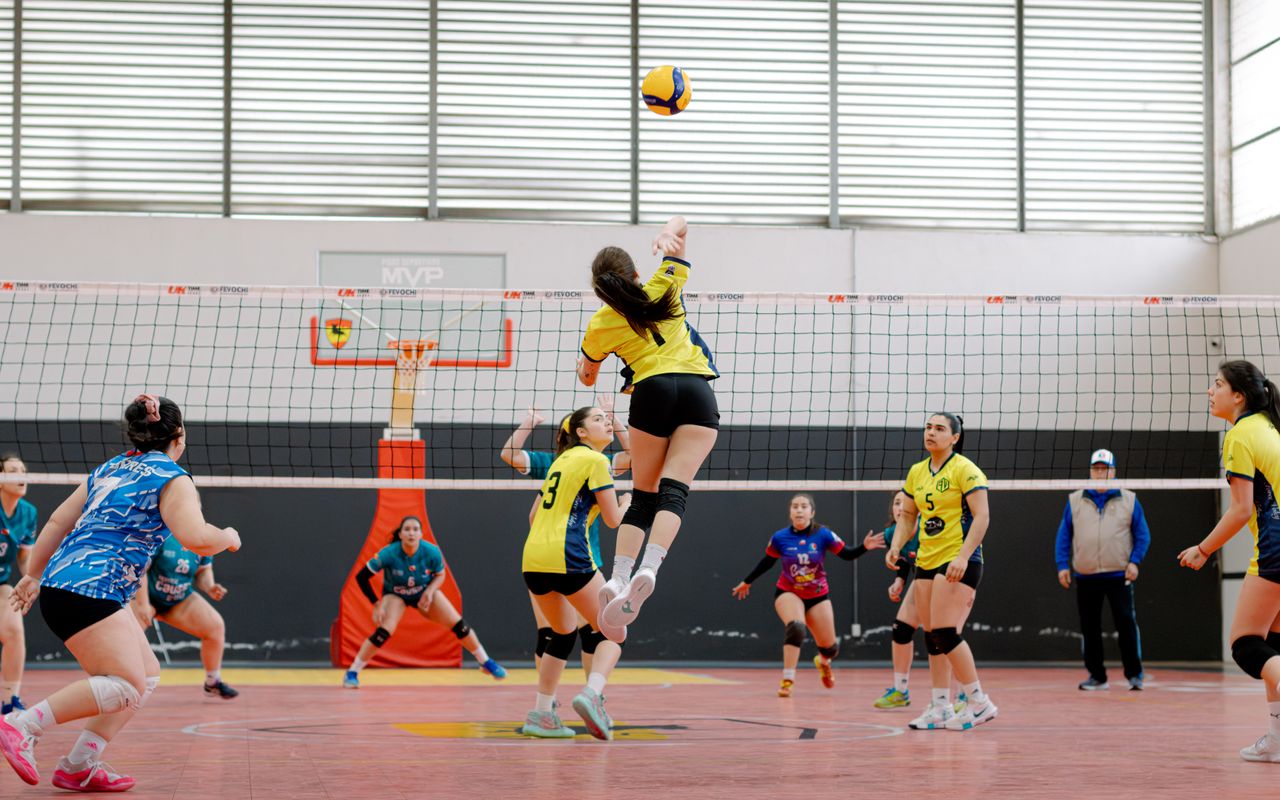
Indoor volleyball remains the center of North Carolina’s competitive volleyball identity. Beach volleyball matters along the coast and in pockets of the state, but the state’s deepest structure is still six-on-six indoor volleyball. That is where the schools compete, where most clubs train, where college programs recruit, and where the most consistent player development happens.
The style of North Carolina indoor volleyball is shaped by its place in the Southeast. It is athletic, increasingly technical, and heavily influenced by club systems that emphasize position-specific training. The strongest teams usually separate through serve pressure, passing stability, and transition scoring. The best outside hitters have to handle more than kills; they need to pass in serve receive, defend seams, and score out-of-system. Middles need to close blocks and run quick tempo when the pass allows it. Setters need to manage uneven first contact and still create hittable rhythm across the pins. Liberos often become the difference between a good team and a serious tournament team.
That technical detail matters because North Carolina is no longer just a participation state. It is a recruiting market. College coaches across the region can evaluate players in North Carolina without treating the state as a secondary stop. The best players can compete in regional and national club events, play challenging high school schedules, and find college options at different levels. Some stay in-state. Others move into broader NCAA volleyball markets across the Southeast, Mid-Atlantic, and beyond.
Men’s volleyball is still less developed than the women’s game, which follows the broader pattern in many states. Boys volleyball has pockets of interest, especially around larger metro areas, but the state’s primary competitive infrastructure remains girls and women’s volleyball. That gives North Carolina a clear strength but also a growth opportunity. If boys volleyball expands through clubs, schools, and grassroots programming, the state’s volleyball identity could become more balanced over time.
Beach and Outdoor Volleyball Add a Different Layer
North Carolina’s coastline gives the state a volleyball dimension that many inland states do not have. Beach volleyball is not the dominant competitive identity statewide, but it is a meaningful part of the volleyball picture, especially around Wilmington, the Outer Banks, and other coastal communities. The sand game gives athletes a different technical education: reading the wind, controlling shots, serving strategically, defending more court, and becoming comfortable without the specialization of indoor volleyball.
For indoor players, beach volleyball can be an excellent complement. It sharpens ball control, forces attackers to develop shots, and makes defenders responsible for more space. A six-rotation outside hitter or libero who spends time in the sand often returns indoors with better court sense and more confidence in imperfect rallies. In that sense, beach volleyball in North Carolina is not just a recreational summer activity. It can be part of the player-development ecosystem.
Outdoor volleyball also appears in grass tournaments, parks, college campuses, and adult events. That part of the scene matters culturally because it keeps volleyball visible outside the formal school and club calendar. In a state with warm weather, beaches, lakes, and a growing young adult population in cities like Charlotte and Raleigh, recreational volleyball can introduce new players to the sport and keep former athletes involved after school or college competition ends.
Where North Carolina Volleyball Is Heading
North Carolina volleyball is moving toward a stronger, more connected future. The state has the ingredients that usually support long-term volleyball growth: population expansion, major universities, strong suburbs, a coastline, competitive high school sports, and a club structure that continues to mature. It also sits in a region where volleyball is becoming more competitive each year, with neighboring states investing in clubs, facilities, and college programs.
The next step is consistency. North Carolina already has strong pockets. The challenge is turning those pockets into a statewide reputation. That means deeper coaching, more boys volleyball, stronger beach pathways, better access outside wealthy suburbs, and continued success from college programs that can keep the sport visible. If those pieces keep developing, North Carolina can become more than a good volleyball state. It can become one of the Southeast’s most complete volleyball markets.