The Netherlands has one of Europe’s most distinctive volleyball identities because it does not fit neatly into a single category. It is not only an indoor volleyball country, though its men’s Olympic gold medal in 1996 remains one of the defining achievements in Dutch team-sport history. It is not only a beach volleyball country, though the Dutch have become one of Europe’s most visible nations on the international sand circuit. It is not only a school, club, or federation-driven market, though the sport depends heavily on organized local clubs, regional development, and a national system that has produced elite players across multiple generations.
Dutch volleyball is best understood as a hybrid scene: technically serious, internationally ambitious, and unusually balanced between indoor and beach. The country’s volleyball culture reflects many of the traits associated with Dutch sport more broadly: structure, tactical intelligence, strong coaching, attention to player development, and a willingness to build national programs around long-term competitive targets. The Netherlands may not have the population size of volleyball giants such as Brazil, the United States, Italy, Turkey, Poland, or Japan, but it has repeatedly created teams and players capable of competing with them.
That dual identity gives volleyball in the Netherlands a different texture from many European countries. Indoor volleyball has the deeper club roots and the strongest historical achievement. Beach volleyball has given the country a modern international profile, especially because the Dutch coastline, urban beach culture, and federation support have helped create a recognizable beach program despite the country’s northern climate. Together, they form a national volleyball story built around adaptation: the Netherlands has learned how to compete indoors, develop players through clubs, and turn a relatively small coastline into a serious beach volleyball platform.
The Legacy of the Dutch Indoor Game
Any serious discussion of volleyball in the Netherlands eventually returns to the men’s national team of the 1990s. That era gave Dutch volleyball its clearest global signature. The Netherlands did not merely have a competitive team; it had a team that changed the way the country was viewed in international volleyball. The peak came at the 1996 Olympic Games in Atlanta, where the Dutch men won gold after one of the most memorable tournament runs in Olympic volleyball history.
That Olympic title remains the central reference point for Dutch volleyball because it represented more than one strong roster having a good event. It was the product of a serious national-team project, a group of elite players, and a coaching structure that helped the Netherlands challenge the best indoor programs in the world. Players such as Ron Zwerver, Peter Blangé, Olof van der Meulen, Bas van de Goor, Mike van de Goor, Henk-Jan Held, and others became part of the country’s volleyball memory. They gave Dutch volleyball a standard that later generations would be measured against.
The style of that Dutch team mattered as much as the result. The Netherlands played with size, discipline, and tactical clarity. Blangé’s setting helped organize a fast and varied attack. Zwerver gave the team a high-level outside presence. The Van de Goor brothers brought physicality, blocking, and middle-of-the-net authority. It was not simply a team of tall athletes hitting over opponents; it was a balanced international side with structure in serve receive, transition, blocking, and offensive distribution.
For Dutch volleyball, the 1990s created a permanent proof of concept. The country could build an elite indoor team. It could compete with the world’s strongest volleyball nations. It could produce players with the technical and mental qualities needed to win the biggest matches. That achievement still shapes how volleyball is discussed in the Netherlands, even as the sport has changed and the competitive field has become deeper.
The challenge after a golden generation is always continuity. The Netherlands has remained relevant in European and international volleyball, but the men’s team has not consistently lived at the same altitude as the Atlanta generation. That is not unusual. Volleyball powers rise and reset as player pools change, club systems evolve, and international competition becomes more specialized. What remains important is that the Netherlands has never been a country without volleyball memory. The Olympic gold gave the sport a national reference point, and that reference point continues to influence expectations around the Dutch indoor game.
Women’s Volleyball and the Country’s Modern Competitive Profile
If the Dutch men’s program carries the weight of the Olympic gold era, the women’s national team has been central to keeping the Netherlands visible in modern international volleyball. Dutch women’s volleyball has built a strong European identity through major tournament runs, high-level players, and a style that has often combined physical attacking with organized backcourt play.
The women’s program has had several important competitive moments, including European Championship success and deep runs in major international competitions. The Netherlands has regularly been part of the conversation in European women’s volleyball, a region where the standard is exceptionally high. Competing against nations such as Italy, Serbia, Turkey, Poland, Russia, Germany, and Belgium requires more than occasional talent. It requires a pipeline of outside hitters, middles, setters, opposites, liberos, and coaches who can function in elite systems.
Dutch women’s volleyball has produced players who became recognizable beyond the domestic scene. Lonneke Slöetjes brought high-level opposite play and scoring power. Maret Balkestein-Grothues offered leadership and outside-hitter stability. Robin de Kruijf became one of the best-known Dutch middles of her generation, with a strong professional career in Italy. Anne Buijs, Celeste Plak, Laura Dijkema, Manon Flier, and others have helped define different phases of the national team’s identity. These players were not just national-team names; many played in major European leagues, where Dutch athletes have tested themselves against the highest club standards.
The women’s team’s fourth-place finish at the 2016 Olympics in Rio de Janeiro remains one of the major modern benchmarks. Even without a medal, that result mattered because it placed the Netherlands close to the center of the global women’s game. Olympic semifinal appearances are not accidental. They require depth, match management, and the ability to survive the emotional and tactical pressure of a tournament format. For Dutch volleyball, Rio showed that the women’s program could carry international ambition in the modern era.
The Dutch women’s team has also helped broaden volleyball’s profile inside the country. Men’s volleyball history may still be anchored by Atlanta, but women’s volleyball has supplied much of the recent national-team relevance. In a sports environment where football dominates attention and field hockey, speed skating, cycling, and other sports have strong cultural positions, women’s volleyball has needed real international results to maintain visibility. The Dutch women have provided that.
A Club System That Gives the Sport Its Base
The Netherlands’ volleyball strength does not come only from national teams. Like many European volleyball countries, its foundation is the club system. Local clubs matter because they introduce players to the sport, provide coaching, organize youth teams, and create the competitive rhythm that feeds higher levels. Dutch volleyball is not built around one giant national academy or a single professional franchise model. It is spread across communities, clubs, schools, regional competitions, and national structures.
The Dutch club scene has historically included both men’s and women’s programs that compete domestically and, in stronger cycles, test themselves in European club competition. Clubs such as Dynamo Apeldoorn, Lycurgus Groningen, Orion Doetinchem, Sliedrecht Sport, VC Sneek, and others have been part of the country’s volleyball landscape. The specific balance of power changes over time, but the broader point is that Dutch volleyball depends on clubs with enough organization to develop players and sustain competitive teams.
This club base gives the sport a different character from places where volleyball is almost entirely school-based. In the United States, for example, high school, college, and junior club volleyball create a distinctive pathway. In the Netherlands, clubs play a more central structural role. They are where many athletes first learn proper technique, where young players begin to understand positions, systems, rotations, and serve receive, and where the transition from recreational participation to competitive volleyball becomes possible.
The club model also helps explain why Dutch players often fit well into professional environments abroad. A player who has grown up in a structured club setting is usually familiar with tactical systems, team training, and positional specialization. Dutch athletes who move into leagues in Italy, Germany, Belgium, France, Poland, or Turkey often arrive with a sound volleyball education. They may still need to adapt to speed, physicality, and professional pressure, but the technical base is usually there.
The challenge for the Dutch club system is scale. The Netherlands can produce high-level players, but it does not have the same domestic professional depth as Europe’s largest volleyball markets. That means many top Dutch players eventually need international club experience to reach their ceiling. This is not a weakness as much as a reality of European volleyball economics. The Dutch system develops players; stronger foreign leagues often refine them.
Beach Volleyball and the Dutch Sand Identity
Beach volleyball gives the Netherlands one of its most interesting contrasts. On paper, the country is not the obvious beach volleyball powerhouse. Its coastline is real and culturally important, but the climate is not Brazil, Southern California, Australia, or the Mediterranean. Yet the Dutch have become one of Europe’s strongest and most organized beach volleyball nations, especially in the modern international era.
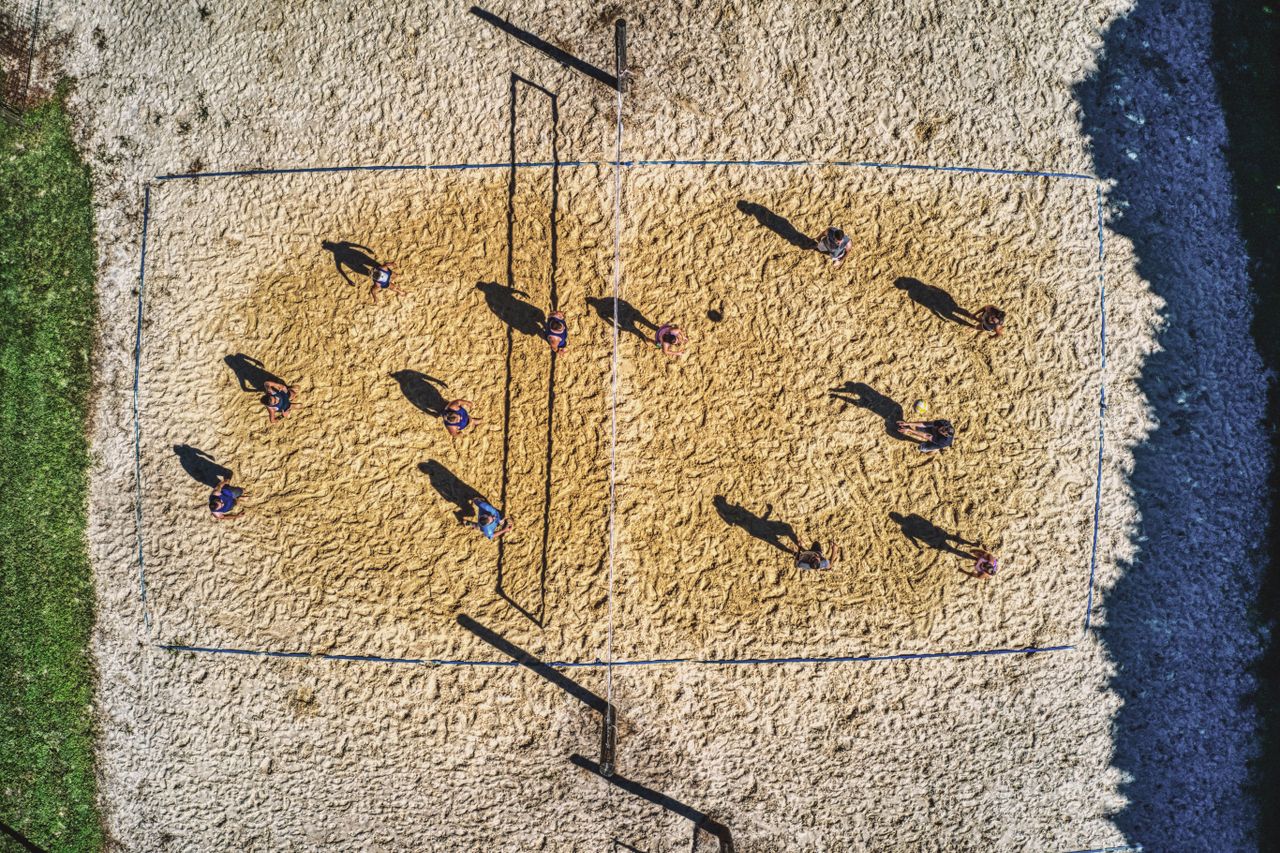
The center of the Dutch beach volleyball image is the North Sea coast, particularly places such as Scheveningen and The Hague. The beach scene there has helped create a recognizable Dutch sand culture: serious training, major events, urban beach facilities, and a federation-backed approach to international competition. The Netherlands has also used temporary and urban venues effectively, bringing beach volleyball into city centers and public spaces rather than treating it only as a seaside sport.
Dutch beach volleyball has produced major international players and teams. Reinder Nummerdor and Richard Schuil were among the country’s best-known men’s pairs, combining indoor experience with beach success. Alexander Brouwer and Robert Meeuwsen gave the Netherlands a world championship-winning pair and became central figures in the country’s beach volleyball reputation. Their success helped prove that Dutch beach volleyball could compete at the highest level, not just participate in European events.
The Dutch approach to beach volleyball is more systematic than romantic. It is not simply a casual beach culture that accidentally produces good players. The Netherlands has treated beach volleyball as a performance discipline: technical training, physical preparation, tactical serving, blocking-defensive systems, and international scheduling all matter. Dutch teams are often known for their organization, size at the net, and ability to play disciplined points against elite opponents.
That makes the Netherlands an important case study in how a northern European country can build a beach volleyball identity. Climate helps, but it is not everything. Courts, coaching, federation investment, athlete conversion from indoor volleyball, and event culture all matter. The Dutch have used those tools well enough to become a regular presence on the international beach circuit.
Beach volleyball also gives the sport a public-facing visibility that indoor volleyball sometimes struggles to match. Outdoor events, stadium courts on sand, and summer tournaments can attract casual spectators in a way that club league matches may not. For the Netherlands, beach volleyball has become both a competitive pathway and a showcase product.
The Indoor-Beach Connection
One of the more important features of Dutch volleyball is the relationship between indoor and beach. In some countries, the two versions of the sport operate almost as separate worlds. In the Netherlands, there has been meaningful overlap. Indoor players have moved to beach volleyball, and beach athletes often carry indoor technical foundations with them.
This matters because beach volleyball rewards complete skill sets. A beach player must serve, receive, set, attack, block or defend, read the opponent, and manage wind, weather, and space. Players who grow up with strong indoor fundamentals often have advantages when they transition to the sand, especially if they have good ball control and tactical awareness. Dutch volleyball has been able to use its indoor culture as part of its beach development base.
The reverse is also true. Beach volleyball can sharpen skills that benefit indoor players. Touch, reading, serve pressure, communication, and defensive anticipation all improve on the sand. Even athletes who remain primarily indoor players can benefit from exposure to outdoor volleyball. In a country with both a structured club scene and a serious beach program, that cross-pollination can make the overall volleyball environment stronger.
The Netherlands’ volleyball identity is strongest when these two sides are not treated as rivals. Indoor volleyball provides history, club infrastructure, and national-team legacy. Beach volleyball provides modern visibility, international medals, and a strong event culture. Together, they give the country more ways to stay relevant.
Player Development in a Compact Volleyball Country
The Netherlands has some natural advantages for volleyball development. It is a compact country with strong transportation links, a deep sporting culture, and a population that generally values organized club participation. Those traits make it easier for players to access regional competition, move between clubs, attend national-team camps, or be identified by coaches.
Height has also played a role in Dutch volleyball’s international reputation. The Netherlands is known for producing tall athletes, and volleyball is one of the sports where that physical profile can become a major advantage. Size alone does not make a volleyball player, but it matters for blocking, attacking, serving angles, and net presence. When height is paired with technical training and tactical structure, it becomes a serious asset.
The country’s development system still has to compete with other sports for athletes. Football is the obvious giant, but Dutch sport also has strong traditions in field hockey, cycling, speed skating, tennis, rowing, and other disciplines. Volleyball must earn its athletes, especially on the men’s side, where football’s pull can be overwhelming. For girls and women, volleyball has a stronger participation profile in many communities, helped by the visibility of the women’s national team and the accessibility of club volleyball.
The development pathway is not only about producing professionals. Dutch volleyball also depends on broad participation. Local clubs need enough young players to form teams, enough coaches to teach proper technique, and enough competition to keep players engaged through adolescence. The best volleyball countries usually have a wide base beneath their elite programs. The Netherlands has often been strong because its volleyball culture is not limited to a handful of national-team athletes; it is distributed through clubs and communities.
At the elite end, the key question is how to move promising players into the right competitive environments. For many Dutch athletes, that means domestic development first, then international experience. A top player may need to play abroad to face faster offenses, stronger serves, more physical attackers, and higher-pressure professional matches. The Netherlands can develop the foundation, but the global volleyball marketplace often supplies the finishing school.
Tournaments, Events, and the Dutch Volleyball Stage
The Netherlands has also mattered as a host country. Hosting events is important because it does more than bring matches to local fans. It exposes young players to elite volleyball, gives national teams a home platform, strengthens federation visibility, and helps sponsors and media see the sport as an event product.
The country has hosted major indoor and beach volleyball competitions, and Dutch cities have shown an ability to stage volleyball in ways that feel modern and accessible. Beach volleyball in particular has benefited from this. Stadiums on sand, urban beach events, and international tournaments have helped create a public image for the sport beyond traditional club environments.
Indoor volleyball events have also given Dutch fans chances to connect with the national teams. When the women’s team has played major matches at home, the atmosphere has often shown that volleyball can draw attention when the stakes are clear and the presentation is strong. The challenge is converting those peaks into sustained week-to-week attention for clubs and domestic competitions.
That tension exists in many volleyball countries. National teams and major tournaments can attract casual fans. Domestic leagues need deeper habits: local loyalty, media coverage, identifiable stars, and consistent matchday experiences. The Netherlands has enough volleyball history and participation to support that culture, but the sport still operates in a crowded national sports market.
What Dutch Volleyball Is Known For
The Netherlands is known for producing intelligent, system-trained volleyball. That reputation applies across both indoor and beach. Dutch teams are usually not described as chaotic, improvised, or purely emotional sides. Their stronger teams tend to be organized, well-coached, and comfortable with tactical structure.
In indoor volleyball, that means attention to serve receive, transition offense, blocking systems, and positional clarity. Dutch teams have often valued setters who can manage tempo and attackers who understand their roles within the system. The country’s best teams have combined physical size with technical order.
In beach volleyball, the Dutch reputation leans toward discipline, size, and tactical execution. Strong serving plans, blocking presence, and defensive patience have been common themes among the country’s better pairs. The Netherlands may not always produce the flashiest beach volleyball, but it has produced highly credible, difficult-to-beat teams.
The broader identity is pragmatic ambition. The Netherlands knows it is not the largest volleyball nation, but it has repeatedly behaved like a country that expects to compete. That mentality is important. Some countries with similar population sizes are content to participate. Dutch volleyball has usually aimed higher than that.
The Future of Volleyball in the Netherlands
The future of volleyball in the Netherlands depends on how well the country continues to connect its three strongest assets: club development, national-team ambition, and beach volleyball visibility. Each part helps the others. Clubs provide players. National teams create inspiration and competitive benchmarks. Beach volleyball gives the sport public energy and international presence.
For the indoor game, the key will be sustaining player development across both men’s and women’s volleyball. The women’s program has carried much of the recent elite profile, while the men’s program still lives with the legacy and expectations of its Olympic past. Returning to the absolute top tier is difficult, but the Netherlands has enough history, coaching knowledge, and athlete base to remain a serious European volleyball country.
For beach volleyball, the goal is continued international relevance. The Netherlands has already shown that it can produce world-class pairs and host major events. The next step is maintaining depth across multiple teams, developing new athletes, and keeping beach volleyball visible beyond isolated tournament moments.
The sport’s domestic future will also depend on participation. Volleyball needs strong local clubs, trained coaches, accessible facilities, and a clear pathway for young players who want to move from recreational play into serious competition. In that sense, the Netherlands’ compact geography and club culture remain major advantages.
Dutch volleyball has already had one of the great Olympic peaks in the sport’s history. It has also built a respected women’s national-team profile and a beach volleyball program with real international standing. That combination gives the Netherlands a place in volleyball that is larger than its population. It is a country with indoor history, beach ambition, and a development system capable of producing players who can compete well beyond the Dutch border.