Tunisia is one of Africa’s defining volleyball nations, with an identity built first around indoor volleyball, national-team continuity, and club competition. In a country where football usually dominates the public sports conversation, volleyball has carved out a different kind of reputation: more specialized, more gym-based, and strongly tied to the structure of Tunisian sport. The national team has long been one of the continent’s most recognizable programs, while clubs from Tunis, Sfax, Kelibia, Carthage, and other volleyball centers have helped keep the sport connected to both elite competition and local development.
The clearest way to understand Tunisian volleyball is to see it as a serious indoor volleyball country with a supporting beach and coastal scene. Tunisia’s Mediterranean geography gives the sport a natural outdoor setting, especially in places such as Hammamet and other coastal areas, but the national reputation comes from six-player volleyball: the men’s national team, the country’s domestic clubs, African championship results, and a history of producing players capable of competing beyond the region.
For decades, Tunisia has been one of the main reference points for men’s volleyball in Africa. The country has not simply appeared in continental competition; it has often been the team others have had to measure themselves against. That gives Tunisian volleyball a sharper profile than many emerging volleyball countries. The sport is not new, experimental, or dependent only on recreational interest. It has institutional memory, club rivalries, national-team expectations, and a competitive vocabulary shaped by years of matches against Egypt, Cameroon, Algeria, Morocco, and the rest of the African field.
A North African Volleyball Power
Tunisia’s strongest volleyball identity is tied to the men’s national team. Across African volleyball history, Tunisia has been one of the continent’s standard-setters, especially in the African Men’s Volleyball Championship. Its championship tradition stretches across eras, with title-winning teams from the late 1960s through the modern period. That kind of continuity matters. It means Tunisian volleyball is not remembered for a single golden generation. Instead, the country has repeatedly rebuilt teams, developed new attackers and setters, and remained relevant as African volleyball changed around it.
The national team’s legacy is also connected to international exposure. Tunisia has appeared on the Olympic stage, at World Championships, and in major FIVB competitions, giving the program a wider profile than most African volleyball nations. Those global events have often been difficult, as African teams typically face deeper professional systems from Europe, South America, and Asia. But Tunisia’s continued qualification history has made the program familiar with high-tempo offenses, taller blocking systems, heavy serving pressure, and the demanding rhythm of world-level volleyball.
That international experience feeds back into the local game. When Tunisian players return from World Championship or Olympic competition, the standard inside the country rises. Younger players see the technical gap between African competition and the world’s top teams. Coaches absorb tactical lessons about serve receive patterns, transition speed, blocking discipline, and offensive distribution. Clubs become part of that development cycle because the national team depends on a strong domestic base as well as players who gain experience abroad.
Tunisia’s most important continental rivalry is with Egypt, another historically powerful African volleyball nation. Matches between Tunisia and Egypt carry more than ordinary regional weight because they often influence qualification routes, medals, rankings, and continental hierarchy. Cameroon, Algeria, Morocco, and other African programs have also played important roles in challenging Tunisia, but the Tunisia-Egypt axis has been one of the major competitive threads in African men’s volleyball. For Tunisia, staying at the top has usually meant surviving that North African and pan-African pressure.
The Style and Strength of Tunisian Indoor Volleyball
Tunisian volleyball has traditionally depended on a balanced indoor game: strong opposite hitters, physical middle blockers, disciplined setters, and enough defensive structure to compete through long rallies. The country’s best teams are usually not built around one flashy trait alone. They need serving pressure to disrupt bigger opponents, blocking organization to slow elite attackers, and enough side-out efficiency to keep matches from running away.
At the African level, Tunisia has often had the technical advantage of continuity. A national team that appears regularly in major competitions develops a shared understanding of how to handle pressure points. That shows up in late-set management: avoiding careless service errors, trusting the setter, using the middle when reception allows it, and finding ways to win points even when the first attack does not score. Those details separate established volleyball countries from teams that only occasionally reach the highest level.
The opposite position has been especially important in Tunisia’s modern identity. In international volleyball, the opposite is often the bailout attacker, the player expected to score against organized blocks when reception is off the net. Tunisian volleyball has leaned on players in that role to stabilize matches, especially against teams with larger blockers or more physical wing attackers. Strong opposite play gives Tunisia a chance to survive imperfect passing and still produce points from high balls, back-row attacks, and transition swings.
Tunisia has also produced outside hitters who can carry heavy workloads. In modern volleyball, the outside hitter is not simply an attacker. He has to pass, defend, block, and attack from different zones. For a national team trying to compete internationally, the quality of the outside hitters often determines whether the offense can stay balanced. If Tunisia can pass well enough to keep its setter in rhythm, the team becomes much harder to defend. If reception breaks down, opponents can load up against the opposite and force Tunisia into predictable swings.
The middle blocker position is another key part of the country’s profile. At the African level, Tunisia has often had enough size and timing in the middle to pressure opponents at the net. Internationally, the challenge becomes speed: reading faster setters, closing blocks against elite pins, and still being available in transition. Tunisian teams that can involve the middle early usually look more balanced and more confident. When the middles are active, the outside hitters and opposite get cleaner matchups.
Clubs as the Backbone of the Game
Tunisia’s volleyball credibility is not only a national-team story. The club system gives the sport its weekly structure, its rivalries, and its player-development base. Clubs such as Espérance Sportive de Tunis, Club Sportif Sfaxien, CO Kelibia, and Carthage-linked programs help create the competitive ecosystem beneath the national team. These clubs do not function merely as local teams; they are part of Tunisia’s broader sports institutions, often connected to multi-sport club identities with deep followings in other sports as well.
Espérance de Tunis is one of the major names in Tunisian men’s volleyball. Its volleyball section has built a major domestic and continental résumé, giving Tunisia one of its most recognizable club brands in African volleyball. In a country where club identity can carry strong emotional meaning, a volleyball team attached to a large sports institution benefits from visibility, infrastructure, and expectations. That matters in a sport that requires indoor facilities, coaching continuity, travel budgets, and year-round training.
Club volleyball also gives Tunisian players a place to develop under meaningful pressure before they enter the national-team environment. Domestic league matches, cup finals, African club competitions, and Arab club tournaments all provide different levels of intensity. A young outside hitter may learn the basics in youth competition, but he learns late-set pressure in league matches and continental tournaments. A setter may have technical ability, but club volleyball reveals whether he can manage a match plan against experienced blockers.
The Tunisian club scene has also given the country a hosting role in African volleyball. Tunisia has staged major African club events, reinforcing the country’s place as a volleyball organizer as well as a competitor. Hosting continental tournaments matters because it brings elite African clubs into Tunisian halls, gives local players and fans more exposure to different playing styles, and places the country inside the administrative life of the sport.
Women’s club volleyball is also part of Tunisia’s wider profile, with Carthage and Sfaxien among the names associated with the women’s game. The women’s national-team story has not carried the same continental weight as the men’s program, but the existence of competitive women’s clubs matters for the sport’s depth. A strong volleyball country needs more than one senior men’s team. It needs girls’ development, women’s teams, coaching pathways, and visible clubs that make the sport accessible beyond the male elite.
Tunisia’s Place in African Competition
Tunisia’s volleyball reputation is inseparable from African championship play. The country’s best teams are judged first by how they perform against the continent’s strongest opponents. African competition is where Tunisia’s status is earned, defended, and sometimes challenged. Every cycle brings the same pressure: qualify, medal, reach finals, and maintain enough continental standing to return to the world stage.
The African game has become more competitive as investment has spread across the continent. Egypt remains a major force. Cameroon has produced dangerous teams with physical attackers. Morocco and Algeria continue to matter in North African matchups. Rwanda, Kenya, Nigeria, and other countries have become more visible through hosting, club events, and development activity. For Tunisia, that means past success does not guarantee future control. The national team has to keep refreshing its roster and adapting to opponents who are taller, stronger, better coached, and more internationally exposed than previous generations.
That pressure is healthy for Tunisian volleyball. A program that wins too easily can stagnate. Tunisia’s best moments have often come when the team has had to respond to a serious continental challenge. Matches against Egypt or Cameroon can expose weaknesses in reception, serving consistency, or transition defense. Those weaknesses then become development priorities. In that sense, Tunisia’s rivals have helped sharpen the program.
Continental success also shapes public perception. Volleyball does not need to compete with football for mass attention in Tunisia to have meaning. It only needs moments that remind the country it has a genuine international sporting asset. African titles, World Championship appearances, and high-stakes regional matches give volleyball that platform. The sport’s audience may be narrower than football’s, but within Tunisian sport, volleyball has earned a respected place.
Beach Volleyball and the Mediterranean Edge
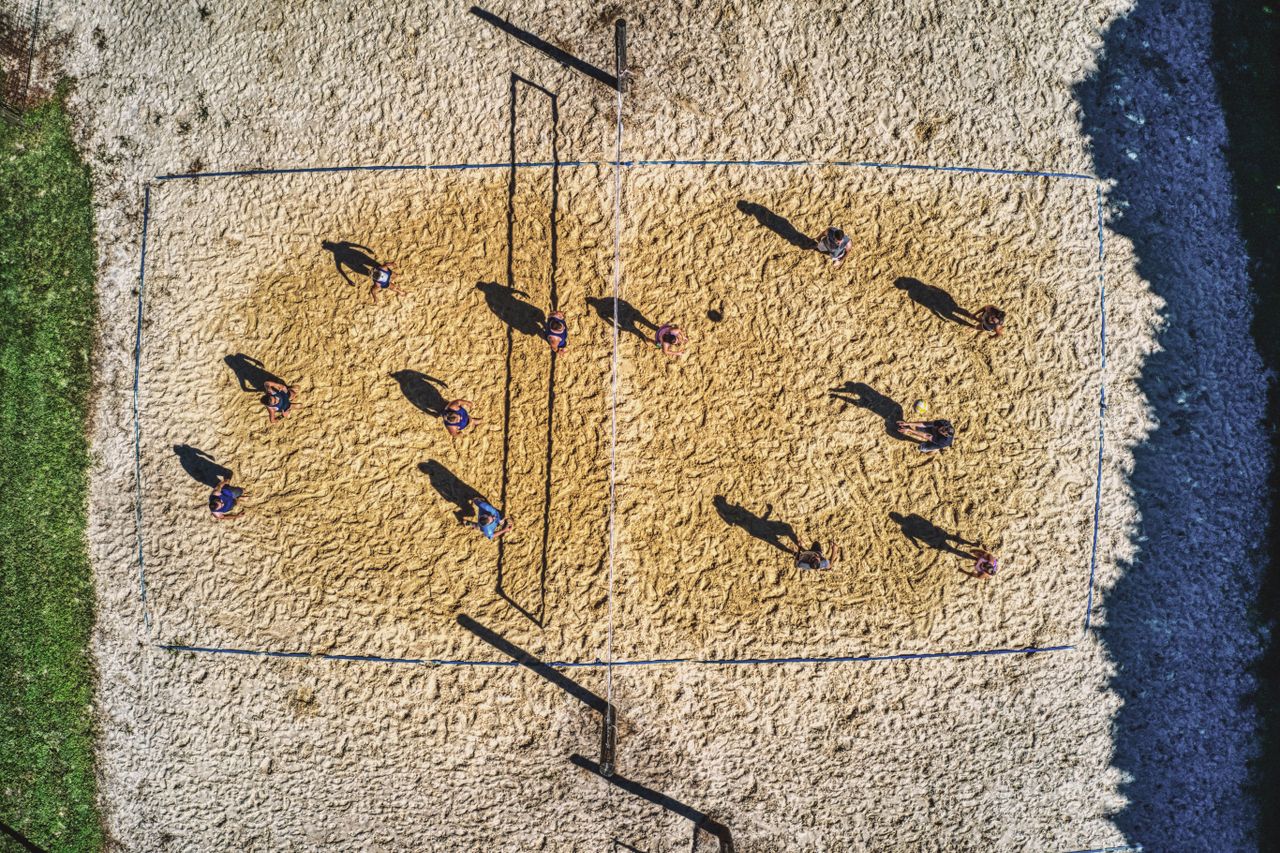
Tunisia’s volleyball identity is indoor-first, but beach volleyball has an obvious place in the country’s broader sports landscape. With a long Mediterranean coastline, resort towns, and beach communities, Tunisia has natural conditions for sand volleyball. Places such as Hammamet give the sport a coastal stage that differs from the indoor halls of Tunis or Sfax.
The challenge is that natural geography does not automatically create a world-class beach volleyball system. Beach volleyball requires specialized coaching, pairs chemistry, tournament access, sand-specific conditioning, and enough competitions to develop tactical instincts. Indoor players can transition to sand, but elite beach volleyball is its own discipline. Players have to cover more space, serve with different strategic intent, manage wind and sun, and attack without the same offensive structure they rely on indoors.
Still, Tunisia’s role as a beach-event host gives the country a meaningful foothold. Hosting African beach competitions puts Tunisian volleyball into a broader continental movement where coastal and warm-weather countries try to develop the sand game more seriously. Beach volleyball also gives the country a different development pathway. Not every athlete fits the indoor model. Some players are better suited to the open-court reading, ball control, and endurance required on sand.
For the national volleyball ecosystem, beach volleyball can serve several purposes. It can broaden participation, especially in coastal regions. It can give Tunisia visibility in multi-sport beach events. It can also help indoor players improve touch, movement, and defensive range. Even when beach volleyball is not the country’s main competitive strength, it can still strengthen the overall volleyball culture.
Player Pathways and Development
The Tunisian volleyball pathway is built through clubs, schools, federation structures, and senior competition. Like many countries with strong indoor traditions, Tunisia depends heavily on clubs to identify and polish talent. Young players need early technical instruction: platform angles, footwork, arm swing mechanics, serving technique, blocking movement, and the basic tactical language of the sport. Without that foundation, athleticism alone is not enough.
The best development systems create repetition without burning players out. Volleyball is a skill-heavy sport, and the difference between an average youth player and a national-team prospect is often thousands of controlled touches: serve receive under pressure, emergency digs, tempo sets, middle approach timing, and transition footwork. Tunisia’s ability to remain relevant in African volleyball depends on whether those touches are happening consistently in youth and junior environments.
Coaching is especially important. A country can produce tall athletes, but it cannot produce high-level volleyball without setters who understand tempo, blockers who read shoulders, liberos who control first contact, and attackers who know how to score when the perfect set is unavailable. Tunisia’s long-term strength has come from having enough volleyball knowledge in the system to develop complete players rather than raw athletes.
The international market also matters. Tunisian players who compete abroad bring back a different level of professionalism. They learn faster offenses, more advanced scouting, stronger weight-room standards, and the daily demands of higher-level club volleyball. When those players return to the national team, they raise the training environment. Younger players can see what the next level requires.
The future of Tunisian development will depend on keeping that pathway wide enough. A few elite clubs cannot carry an entire national volleyball culture alone. The country needs steady participation among boys and girls, qualified coaches outside the biggest clubs, competitive youth tournaments, and enough facilities to keep players training year-round. The more players who receive proper instruction early, the deeper the national pool becomes.
Players Who Define the Modern Era
Modern Tunisian volleyball has been shaped by athletes who gave the national team scoring, leadership, and international credibility. Opposites such as Hamza Nagga and Wassim Ben Tara have been important figures because they represent the attacking responsibility Tunisia needs at the highest level. In world volleyball, the opposite hitter is often the player opponents scout first. If that position is productive, the entire offense becomes more stable.
Ben Tara’s rise has been particularly important because he reflects the value of international club exposure. Players who compete in stronger professional environments sharpen their timing, power, and decision-making against elite blockers. That experience is difficult to replicate domestically. For Tunisia, having players who can handle professional speed outside Africa is essential if the national team wants to compete beyond continental tournaments.
The modern team has also featured players such as Elyes Karamosli, Ahmed Kadhi, Khaled Ben Slimene, Mohamed Ridene, and Oussama Ben Romdhane in prominent roles at different moments. Their value is not only in individual statistics. Together, they show the range of pieces Tunisia needs: outside scoring, setting, blocking, libero play, serving pressure, and emotional steadiness in regional matches.
No national team can live forever on one generation. Tunisia’s challenge is to transition from experienced players to younger ones without losing its competitive standards. That is one of the hardest tasks in international volleyball. A team can look strong with veterans who understand each other, then suddenly look vulnerable when passing patterns, leadership roles, or setter-attacker relationships change. Tunisia’s continued relevance will depend on managing those transitions cleanly.
Volleyball Culture in Tunisia
Volleyball culture in Tunisia is not built around one single image. It is partly national-team pride, partly club identity, partly school and youth participation, and partly the coastal possibility of outdoor volleyball. The indoor game has the deepest roots, but the sport’s culture changes depending on where it is played.
In Tunis, volleyball connects to major clubs, indoor halls, and the broader capital-city sports environment. In Sfax, Kelibia, Carthage, and other volleyball centers, it carries more local character. In coastal areas, the sport can take on a more recreational or beach-oriented identity. This mix gives Tunisia a hybrid volleyball culture, even if the country’s competitive reputation remains strongly indoor.
The atmosphere around important matches is shaped by the stakes of Tunisian club sport. When a volleyball team belongs to a major multi-sport institution, the match is not just a technical contest. It is attached to colors, history, and supporters who may follow the club across different sports. That club culture can make volleyball feel bigger than it otherwise would in a football-heavy country.
At the national-team level, volleyball gives Tunisia another way to project sporting seriousness internationally. African medals and World Championship appearances create a sense of continuity. Players are not representing a novelty sport; they are stepping into a program with expectations. That matters. A strong volleyball culture is not only about participation numbers. It is also about standards, memory, and the belief that reaching continental finals is normal rather than surprising.
The Future of Volleyball in Tunisia
The future of volleyball in Tunisia depends on how well the country protects its traditional strengths while modernizing its development system. The men’s national team has given Tunisia an elite African identity, but the next step is always harder: turning continental status into more consistent world-level competitiveness. That means better serving, faster offense, deeper benches, stronger physical preparation, and more players competing in demanding professional leagues.
Tunisia also has room to grow through women’s volleyball. Stronger girls’ development, more visibility for women’s clubs, and better senior national-team performance would make the country’s volleyball identity more complete. The men’s program has carried much of the international reputation, but a deeper volleyball nation needs both sides of the sport to matter.
Beach volleyball is another growth area. Tunisia has the coastline and the event-hosting experience to become more visible in African beach volleyball. The question is whether the country can build a consistent sand-specific pathway rather than treating beach volleyball as an occasional extension of the indoor game. If Tunisia develops more pairs, more domestic events, and more youth beach training, it can use its geography more effectively.
The club game remains the foundation. As long as Tunisian clubs compete seriously in domestic, African, and Arab competitions, the national team will have a base to draw from. Clubs provide the daily training environment that international volleyball requires. They also create the rivalries and match pressure that shape players before they wear the national shirt.
Tunisia’s volleyball identity is already established. It is an indoor-first African power with a respected national-team history, serious clubs, meaningful rivalries, and a developing beach scene along the Mediterranean. The next chapter is not about introducing volleyball to the country. It is about sustaining a standard that has already been built, expanding the player pool, and turning Tunisia’s African pedigree into more frequent success against the wider volleyball world.