Wisconsin’s volleyball identity is built around the school gym, the college arena, and the kind of indoor volleyball culture that turns technical precision into a statewide calling card. It is not a beach-first volleyball state, and it is not defined by a single metro scene. Wisconsin volleyball is a layered indoor market: high school programs across the state, junior clubs feeding college recruiting pathways, a major Big Ten powerhouse in Madison, and a fan base that treats elite women’s volleyball as a legitimate spectator sport.
The center of that identity is the Wisconsin Badgers. The University of Wisconsin women’s volleyball program has become one of the defining brands in NCAA volleyball, giving the state a national profile far beyond local participation numbers. Wisconsin’s 2021 NCAA championship was a landmark for the program and for the state’s volleyball reputation, not simply because it delivered a title, but because it confirmed what had been building for years: Wisconsin had become one of the places where college volleyball felt big, serious, and culturally anchored.
A Big Ten Volleyball State
The Big Ten has shaped Wisconsin volleyball more than any other competitive structure. In a conference known for physical blocking, strong serving, deep benches, and packed arenas, Wisconsin fits the league’s identity almost perfectly. Badger volleyball has been associated with size at the net, disciplined defensive systems, and the ability to win long matches against opponents that can match it physically.
That matters because Wisconsin’s volleyball reputation is not based on novelty. It is based on repeat performance. The state’s flagship program has spent years in the national conversation, regularly competing with Nebraska, Penn State, Minnesota, Purdue, Illinois, and other Big Ten programs that have helped make the Midwest one of the strongest women’s volleyball regions in the country. Wisconsin’s rise has also helped normalize the idea that volleyball in the state can command attention in the same way more traditional college sports do.
The atmosphere around Badger volleyball is part of the story. Wisconsin Field House has become one of the recognizable venues in the college game, the kind of place where volleyball feels like a major event rather than a secondary campus activity. That environment gives Wisconsin a distinct edge in how the sport is perceived. Young players in the state can see high-level volleyball not as something distant or coastal, but as something being played in front of serious crowds in Madison.
The Badgers and the Standard of Elite Indoor Volleyball
Wisconsin’s modern volleyball identity is closely tied to elite player development and high-level college execution. The Badgers have produced and attracted athletes capable of shaping matches at the national level: dominant middle blockers, polished setters, steady liberos, and outside hitters who can carry scoring responsibility in pressure rotations.
Dana Rettke stands as one of the most important names in that era. As a towering middle blocker with national-team credentials and a long list of collegiate honors, she became a symbol of Wisconsin’s ability to build around elite size and skill without sacrificing system discipline. Lauren Carlini, one of the most decorated setters in program history, represents a different part of the Badger identity: control, leadership, location, tempo, and the ability to run an offense against the best defenses in the country. Sydney Hilley, Sarah Franklin, and other major Wisconsin standouts have added to the sense that the program is not just strong for a season or two, but structurally built to remain relevant.
The effect of that success reaches beyond the roster. A powerful college program changes the volleyball imagination of a state. It gives junior players a visible standard. It gives club coaches a reference point. It gives high school athletes a local example of what polished serve receive, disciplined blocking schemes, and transition offense look like at the highest levels of the college game.
High School and Club Volleyball Across the State
Wisconsin’s volleyball base is not limited to Madison. The sport has deep roots in high school competition, especially on the girls’ side, where volleyball is one of the central fall sports across large and small communities. In many towns, the high school volleyball season functions as a major part of the school sports calendar. Gyms fill for rivalry matches, postseason runs carry local weight, and strong programs become part of a community’s athletic identity.
That school-based structure is important because Wisconsin is not a state where volleyball development depends only on one urban area. Milwaukee, Madison, Green Bay, Appleton, Kenosha, Racine, Eau Claire, Waukesha, and other regions all contribute to the player pool. Some athletes come through larger suburban programs with access to strong club competition, while others emerge from smaller schools where multi-sport participation and year-round athleticism matter.
Junior club volleyball has become increasingly important in that development pathway. Clubs give Wisconsin players exposure to higher-level competition, travel tournaments, recruiting events, and specialized coaching. For athletes trying to move from high school volleyball into NCAA programs, club volleyball often provides the extra reps, tactical speed, and recruiting visibility needed to compete beyond the state level.
The Wisconsin player pathway tends to reward completeness. A hitter cannot rely only on arm strength. A setter has to manage tempo and out-of-system choices. Liberos and defensive specialists need to serve tough, read hitters, and handle heavy first contact. The state’s best programs usually reflect the broader Midwest style: physical enough to compete at the net, but disciplined enough to survive long rallies.
Beyond Madison: College Volleyball’s Wider Footprint
While the Badgers dominate the state’s national image, Wisconsin’s college volleyball landscape extends beyond the Big Ten. Marquette has built a strong Division I presence in Milwaukee, giving the state another nationally relevant program and a major urban anchor for the sport. Other universities and colleges across Wisconsin contribute to the broader ecosystem, especially by creating opportunities for athletes who may not fit the Big Ten profile but still want serious college volleyball.
That range matters. A healthy volleyball state needs more than one elite program. It needs different levels of opportunity: Division I, Division II, Division III, NAIA, junior college, and competitive club environments. Wisconsin benefits from a dense college sports culture, where athletes can pursue volleyball without leaving the region and where local coaches can point players toward realistic next steps.
The result is a more stable volleyball identity. The Badgers may be the national face, but the state’s volleyball culture is supported by a wider foundation of campuses, high schools, clubs, and community gyms.
Beach, Grass, and the Short Wisconsin Summer
Wisconsin is not defined by beach volleyball in the way California, Hawaii, Florida, or parts of the Gulf Coast are. The climate naturally tilts the state toward indoor volleyball, with long winters making gym access central to the sport’s development. Still, outdoor volleyball has a real place in Wisconsin’s recreational culture.
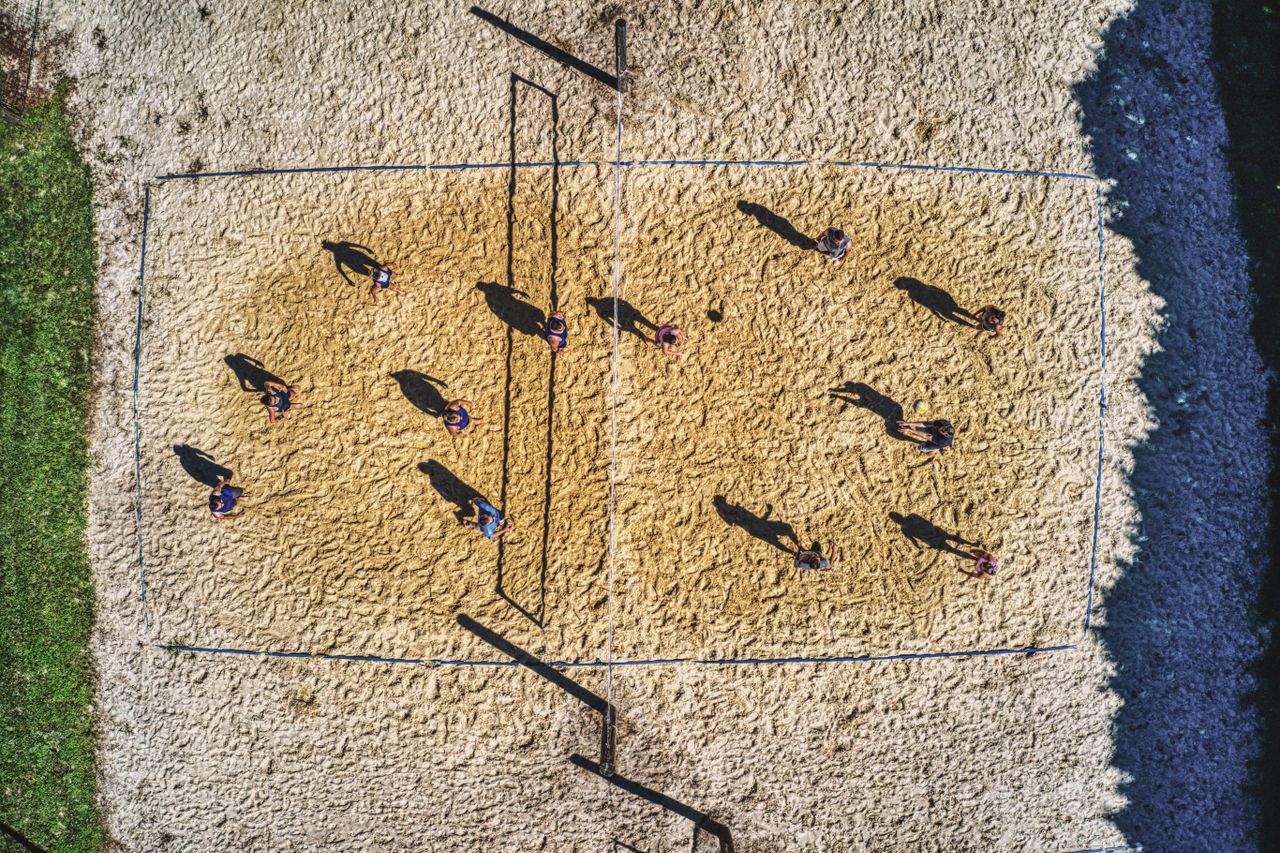
Summer changes the volleyball map. Sand courts, grass tournaments, lakefront parks, and casual doubles or fours become part of the seasonal rhythm. In Milwaukee, Madison, and lake communities across the state, outdoor volleyball gives players a less formal but still competitive outlet. It is especially valuable for ball control, reading angles, and improving all-around skill. A middle who rarely passes indoors may have to handle serve receive on grass. An outside hitter may learn to place shots rather than swing through every block. A setter may have to compete in windy conditions and imperfect contact.
Outdoor volleyball in Wisconsin is not the main identity, but it supports the indoor game. It gives the state’s volleyball culture a summer extension before athletes return to school gyms, club practices, and college arenas.
What Wisconsin Volleyball Represents
Wisconsin volleyball represents the modern rise of women’s indoor volleyball in the United States. It is a state where the sport has moved from participation activity to serious competitive property. The Badgers helped accelerate that shift, but the foundation runs through high school programs, club systems, college opportunities, and a fan base that understands the quality of the product.
The future of volleyball in Wisconsin looks tied to that same structure. The sport is likely to keep growing through girls’ high school participation, junior club expansion, stronger recruiting networks, and the continued visibility of elite college volleyball. Boys’ and men’s volleyball remain areas with more room to grow, but the broader volleyball infrastructure already exists.
Wisconsin’s place in the volleyball landscape is clear: it is one of the country’s strongest indoor volleyball states, not because it has the most beaches or the warmest weather, but because it has built a serious gym culture. The state’s best volleyball is physical, organized, loud, and increasingly national in scope.