Russia’s volleyball identity is rooted in one of the sport’s strongest historical traditions: the Soviet system that treated volleyball as a serious international arena, then the Russian program that inherited much of that expectation. The story is not only about medals. It is about size, structure, coaching, club development, and the belief that volleyball could express national strength through discipline at the net. Soviet and Russian teams became associated with height, blocking, physical serving, and a controlled style that made them difficult opponents across generations. That legacy remains central to volleyball history, even as Russia’s senior national teams remain outside FIVB international and continental competitions under sanctions first announced in 2022.
The Soviet Foundation Behind Russia’s Volleyball Identity
Russia’s volleyball identity cannot be separated from the Soviet Union’s rise as a world volleyball power. Volleyball became an Olympic sport in 1964, and the Soviet men won gold at that first Olympic tournament in Tokyo. The Soviet men later added Olympic golds in 1968 and 1980, while the Soviet women won Olympic gold in 1968, 1972, 1980, and 1988.
Those results shaped the way Russian volleyball would later be understood. The Soviet model was built around centralized training, physical selection, technical repetition, and the prestige of international competition. Volleyball fit that system well. It rewarded height and power, but also demanded timing, positional discipline, and group coordination. Soviet teams were not simply producing isolated stars; they were building repeatable national-team structures.
That inheritance continued after the Soviet Union dissolved. Russia did not have to invent a volleyball culture from scratch. It inherited expectations, coaching knowledge, club traditions, and a public understanding that success in volleyball belonged near the center of national sport. The Russian men’s and women’s teams carried that weight into the post-Soviet era, even as the global field became deeper and more varied.
Height, Blocking, and the Russian Style
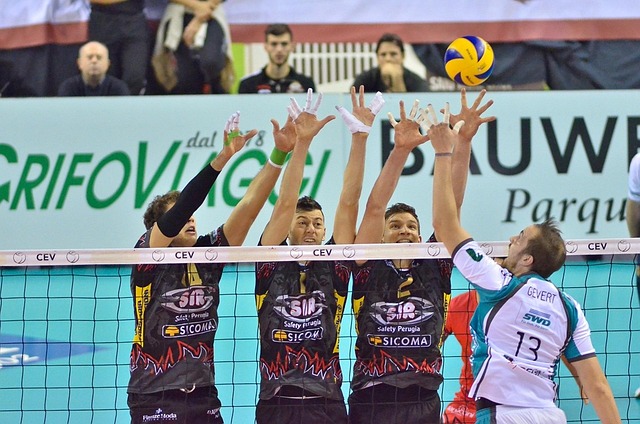
The Russian style has often been associated with physical pressure. At its best, Russian volleyball has used size at the net, heavy serving, and strong blocking to make opponents play under constant stress. That does not mean Russian teams have lacked skill or creativity. It means their identity has often started with the most visible form of volleyball control: winning the space above the tape.
That approach has been especially clear in men’s volleyball, where Russia’s best teams have often featured imposing attackers, strong middle blockers, and servers capable of changing a set quickly. The style can look direct, but it is not simple. A powerful block depends on reading the setter, closing space, and forcing hitters into narrow choices. A heavy serve only matters if the defense and block are organized behind it.
Russia’s club system has also helped maintain that identity. The Russian Super League developed as a continuation of Soviet-era domestic volleyball structures, giving the country a high-level base for player development and professional competition. Clubs such as Zenit Kazan, Dynamo Moscow, and other major Russian programs became part of the country’s broader volleyball infrastructure, keeping elite players in demanding domestic environments and reinforcing the connection between club volleyball and national-team ambition.
A Volleyball Power Outside the Main Stage
The modern chapter of Russia’s volleyball identity is complicated because historical strength now sits beside international absence. In March 2022, the FIVB declared Russian and Belarusian national teams, clubs, officials, and beach and snow volleyball athletes ineligible for international and continental events until further notice. In December 2025, the FIVB created a pathway for young athletes with Russian and Belarusian passports to participate in age-group international and continental events from January 1, 2026, but stated that the senior national-team ineligibility decision remained in effect.
That leaves Russian volleyball in an unusual position. Its historical résumé is too large to ignore, and its influence on the sport’s development remains part of volleyball’s global story. At the same time, the current senior national teams are not part of the main international calendar, which affects how a new generation of fans sees Russia’s place in the sport.
Russia’s volleyball identity is therefore both historic and unsettled. It was built through Soviet dominance, physical style, and deep domestic systems. Its legacy remains visible in how volleyball people talk about power, blocking, and national-team structure. But its future place in the international game depends on when and how Russian teams return to the competitions that once helped define them.